My Mom, The Frustrated Artist

I watched My mom take a lot of art lessons over the years. Her experience greatly influences the way I approach teaching art at Firstlight. I want to make sure that others don’t have the same frustrations.

Mom wanted to go to art school, but my grandfather wouldn’t let her. Instead, she had to get a more practical (in his view) degree that was basically “how to be a good secretary”.

But she was always an artist at heart. We had her paintings up all over our house, and they were really beautiful. There were forest streams in the fall, and snow-clad cabins in the winter.

However, there was one really big problem with them. None of her paintings were her paintings. Each one was a copy of the her teacher’s step-by-step follow-along demonstrations. She was copying the teacher’s style and subject.

I remember her showing me all the cool techniques she had learned, like how to make snow on a rooftop, or add some fall foliage to a tree branch. I really enjoyed hearing about these. We talked about art a lot, and my mom always encouraged me as much as she could.

After a while, and after struggling a lot with her work, it became clear to my mom that she couldn’t make a painting look nearly as good unless she was in the expensive class, following along. She tried over and over. Years later she finally made one really large work that my dad loved and placed over the fireplace, but she wasn’t satisfied with it. It was just a larger, less awesome version of one of the snow-clad cabins.

The inability to create paintings on her own deflated her, and played into the fear that she wasn’t a “real artist”. She kept after it though, and eventually found a watercolor class that allowed her to create paintings she liked. I had gone to art school by this time, and I could see that the teacher wasn’t imparting very good technique. She struggled with these paintings too. She said the teacher pretty much left them on their own most of the time, and painted her own watercolors with them. She would show them what she did from time to time as instruction.

Then one day, she was in an antique and collectibles shop in another state. She saw her own painting! But then she realized it was not her own. It was another student’s painting that had taken the same lessons from the same teacher years before. I didn’t realize until much later, but this was devastating to her. The work had been on our walls for years, but now, to her, it was all fake. Shortly after this she gave up painting, and turned to writing poetry as her creative outlet.

This story is more common than you think. The teachers she had were good artists, and they did what they knew how to do. They painted, and they told their students what they were doing as they did it.

It seems very reasonable. It just doesn’t work very well.

Some students can move past this, and incorporate the follow-along into their own work, but most cannot. Most art students need real training and insights.

My mom was not taught how to find reference; how to compose a work; how to control color mixing; how to draw accurately; and lots of other very important things that make creating art much more accessible – much more satisfying and rewarding. So when she tried to do these things, that had once been easy when following along… she couldn’t.

So at my art school, I make sure we teach these things.

It’s really hard to teach art with a balance. Some teachers allow students to mostly work on their own, developing their art in their own way. Other teachers have students follow along and make copies of their own work.

We want to explain exactly how we do art, yet not force our own style on students. This takes lessons that delve into the nitty, and the gritty, like how an artist analyzes their subject so they can reproduce it accurately, or how to make a bright color look like it’s in a shaded area.

This approach does create some different problems though, and that is with perception. Sometimes I have artists and parents who want to see the pretty snow-clad cabin paintings coming home on a regular basis. They misunderstand the fact that many of our lessons that don’t produce lovely finished artwork.

They can be frustrated with the slow pace of learning such a huge endeavor as art.

I know without a doubt, that there are no shortcuts; no magic method to achieving competence in drawing and painting. But there is good news! Anyone can improve and learn to create their own work at home – if they get past two misconceptions.

1  One is that you are born with talent or you don’t have it. Talents are gifts that make some things easier to learn, or propel some artists to an extremely high level. It’s not necessary to be at that level, or even close, to really enjoy creating your own work though. Even highly gifted artists create work they do not keep and do not show to anyone. I ask students where all of Michelangelo’s work is that he did when he was young and learning art. They don’t know! We don’t have it, because no one kept it. It was practice work.

2  The second misconception, is that you can get quick tricks that will make your work instantly better instead of doing steady practice. I’m sorry, but even though the internet if full of buttons that promise secrets that will instantly change your life, it doesn’t happen with things like playing the piano, or painting a beautiful scene. There is a lot to learn, and it takes time, practice, and a well-trained teacher to incorporate the foundational insights, master the basic techniques, and discover your own personal style.

Our program is actually as short as I can make it for once a week lessons of an hour and 45 minutes. I’ve also worked to ensure that the teaching is consistent. Our teachers use the two-year curriculum I’ve worked on for 12 years now, and they go through weekly training. The curriculum has been written out in specific steps and with set times for each step and sub-step. They have explanations and videos of me doing every single demo that they can access at any time, 24/7/365.

After working with over 1500 students, some for as many as 12 years, I can guarantee you that if you stay with it, and follow our lessons, you’ll be able to work on your own.

You can be the artist you dream about.

Local Frame Shops

Local Frame Shops

<iframe src="https://www.google.com/maps/embed?pb=!1m18!1m12!1m3!1d3231.189296831466!2d-86.87413704891644!3d35.91786632446713!2m3!1f0!2f0!3f0!3m2!1i1024!2i768!4f13.1!3m3!1m2!1s0x88647fad541ca7f7%3A0x192c65d0e1008a33!2sDamico+Frame+%26+Art!5e0!3m2!1sen!2sus!4v1531507913480" width="600" height="450" frameborder="0" style="border:0" allowfullscreen></iframe>

Damico Frame & Art

If you’re looking for someone who will take care to make your work look as good as possible, this is the place you’ll find him. Michael Damico is the best of the best.  Many of our students get there work framed here. Tell him Firstlight sent you!

<iframe src="https://www.google.com/maps/embed?pb=!1m18!1m12!1m3!1d3231.152572375788!2d-86.8375380489164!3d35.918765324417485!2m3!1f0!2f0!3f0!3m2!1i1024!2i768!4f13.1!3m3!1m2!1s0x88647ed8bb1d85f5%3A0x59d2eecfa117a1bb!2sHobby+Lobby!5e0!3m2!1sen!2sus!4v1531508194850" width="600" height="450" frameborder="0" style="border:0" allowfullscreen></iframe>

Hobby Lobby

You can find inexpensive but nice frames and mats for DIY, or you can have the knowledgable folks working here help you with a custom job. They usually have a coupon online, and frames are discounted often (usually every other week).

How To Do Art Supplies

How To Do Art Supplies

Register Now for 2019 - 2020 courses

EVERY STUDENT MUST HAVE A FULL SET OF SUPPLIES BEFORE THE FIRST DAY OF CLASS

Life is crazy so we are trying to make it as easy as possible to get the supplies you need.


Here are two ways to do it, and why it’s important. The first step is…

1. Figure out what you need

Download our handy checklist and see what you’re missing. Make a check mark for everything you need to buy.

2-A. Purchase online at home

Just go to our online store, look at your checklist, and buy what you need as a pick-up order. It will be ready for you or your child when you get to class. ORDER TAX FREE ONLINE THIS WEEKEND: Friday, July 27 – Sunday, July 29. 

Online Store

OR

2-B. Purchase before class at Firstlight

Bring your checklist. We will be at the studio just to help you get supplies and even register if you haven’t. 

Why worry about it?

Class time is for doing art projects and we begin as soon as you sit down. Our curriculum is timed to the minute.

In the past, we have actually had several classes full of students who were dropped off without sketch pads, critical paint colors, or even pencils, asking what to do and with no way to pay for supplies. With over 200 students, and up to 48 at one time, we need for you to get supplies taken care of – before a teacher is faced with an impossible situation. If supplies are not purchased before class, and the student doesn’t have them, we will probably be too overwhelmed to sell them during class-time for the first few weeks. We will not provide free supplies to students who have not restocked their supplies. Your student may be stuck without the supplies to do the projects if you do not restock before we begin.

Thank you for understanding and helping us make art classes fun and easy.SaveSave

SaveSave

Firstlight is open every day but Sunday, from August 9th to August 18th.

  • Weekdays 1 to 6 pm

  • Saturdays 10 am to 5 pm

Little Brush of Horrors

Little Brush of Horrors

Brush-of-horrors

Or, “How I learned to love good art supplies” (Hey, speaking of which, Saturday, July 30 from 10 am to 5 pm is tax free supplies order day at Firstlight)

This is for the artist in your house:

You know that brush? The one that came with that set. That set that your sweet auntie got you for Christmas one year that has 438 pieces, with all those tiny beautiful bits of barely useable rainbow-arranged media in 3 little drawers. That brush.

You like that brush.

Because it came from your Auntie, and it looks so cool with its shiny black lacquer and red stripe.

But you hate that brush.

That brush doesn’t work like other brushes. It bends too much. It spreads out instead of making a point.

Every time you use it creativity changes. Instead of being your greatest joy it becomes a struggle for establishing your dominance over mindless paint. It is so frustrating to use. It makes you fight your work instead of flow.

That’s no small problem for an artist, but thankfully there is an easy fix.

THROW

THE

BRUSH

AWAY

I know it’s hard. I know it goes against all your instincts from many years of wide-eyed trips to art stores and the hoarding of supplies that should have been used up 5 years ago but maybe you can get just one more eensy teensy little squeeze of paint out them. Supplies seem so precious.

But you can do it. That brush is not precious. It is an imposter in a world of useable brushes, that you would not give to your most hated artistic enemy. You know it’s true. Don’t do this to yourself. Make the future more awesome by ridding the world of inferior supplies that make artists fight and sweat instead of dance and sing.

Then relax.

And after you do, find every brush in your home that’s like it. They’re the ones with the plastic handles or those that have been made with the the belly hair of diseased opossums. Toss them too. You’ll feel so much better afterwards. Shoot, I feel better just telling you to throw those lousy brushes away.

Because… the world needs happy artists.

Mr. Dennas
Come see me Saturday and get registered and order art supplies tax free!

Gingerbread Houses at Firstlight

Ginger
bread

Village!

Our Legendary Holiday Project is THIS WEEK!

Everyone loves our Gingerbread Village OPEN HOUSE!

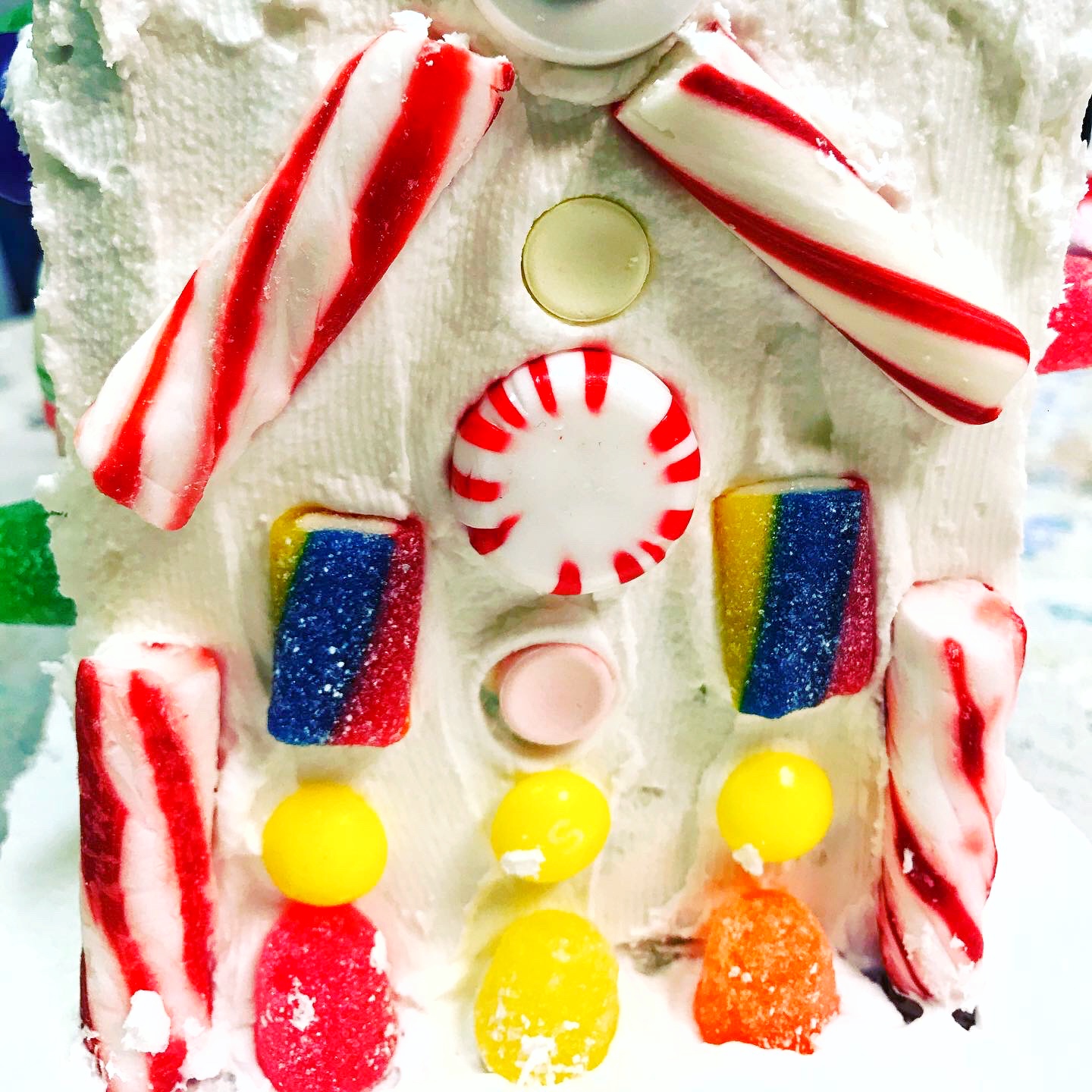
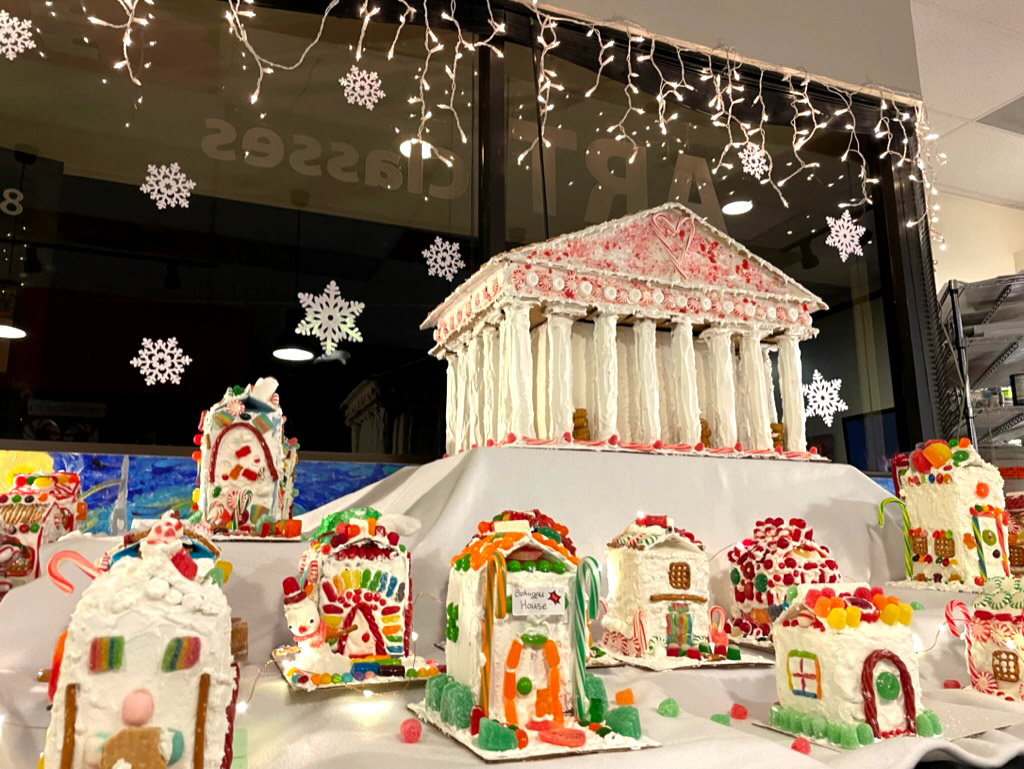
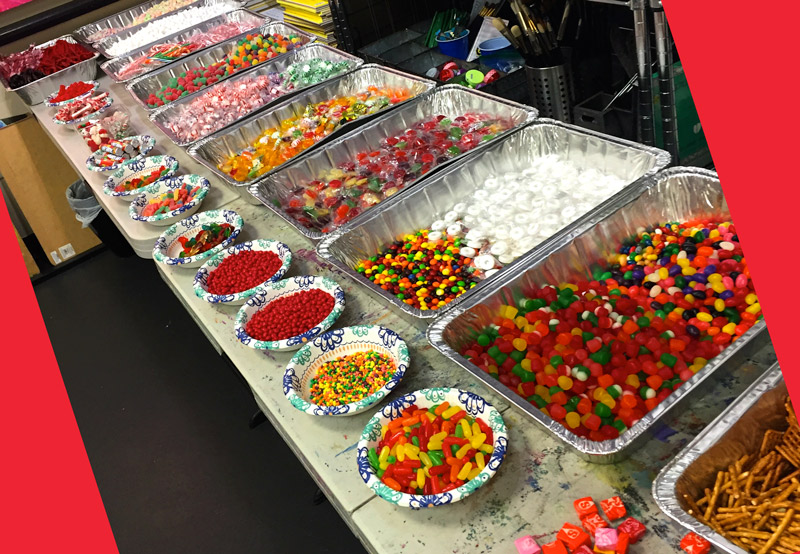
Nearly 200 gingerbread houses made by the students, will become a truly Magical Winter Village at our Open House – Saturday, December 6, from 3-7 pm. Hot cocoa, cider, cookies, and a fire pit out back, will make this a special part of your holiday season!

The gingerbread house projects are made the week after Thanksgiving, Dec 1 – 5

You must bring items in the week BEFORE Thanksgiving break.

You still need to bring 3 items if you haven’t yet!

1, 2, 3. Here’s everything you need to do:

1. Candy

Instructions

Two bags of candy need to be brought in the week of Nov 17 – 21 or before.

Due to allergies and because we KNOW what works best, please bring only these kinds of candy.

  • Lifesavers
  • Licorice strips
  • Jellies and gumdrop candy
  • Mint candies/candy canes/Peppermint sticks
  • Old fashioned candies!
  • Hard candies of any kinds
  • Pretzels
  • Marshmallows
  • Candy Decorations
  • Red hots

(NO chocolate, no nuts, no m&m)

Note: All the candy is SHARED, so we have a big variety for everyone to use.

2. House

Instructions

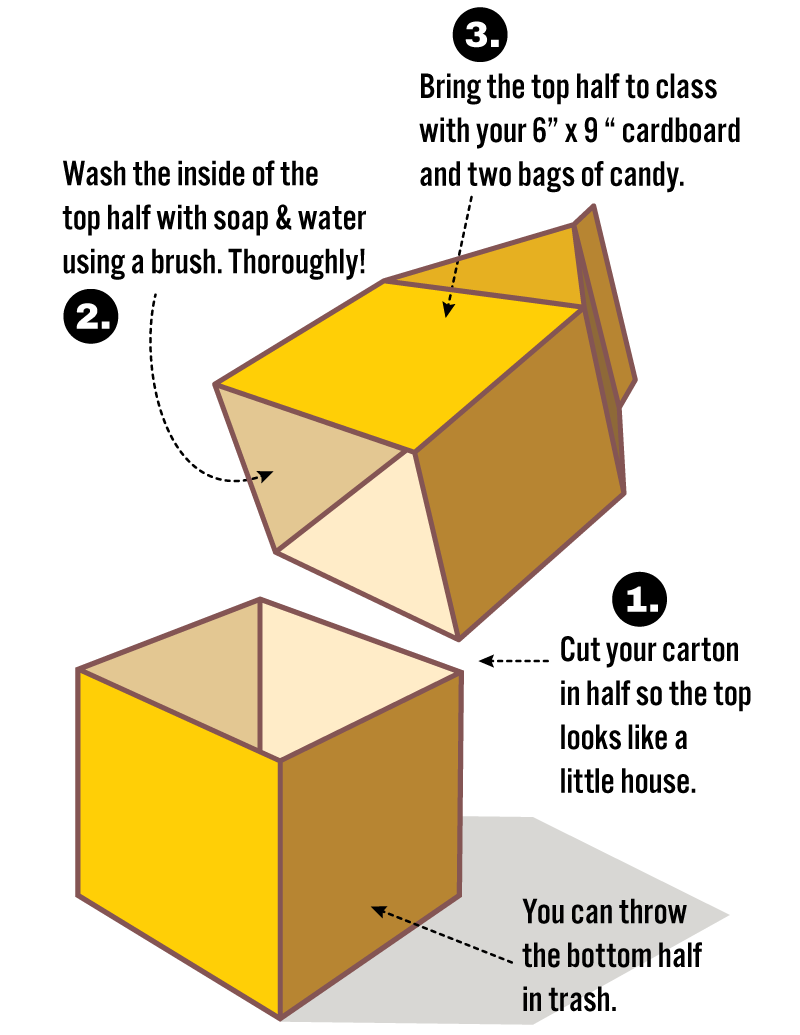
1. Each student must have a half-gallon (old-style) milk or juice CARTON that has a house-like shape at the top.

2. CUT THE BOTTOM OFF !!! so the inside can be CLEANED with SOAP! DO NOT simply rinse it out. Uncut cartons will be thrown away. They will stink. (We know this for sure!)

(CUT The bottom off AND WASH your carton! Thank you!)

3 Base

Instructions

CARDBOARD: Bring flat piece of cardboard – 6″ x 9″ rectangle (so they fit on shelves)

Please cut your cardboard and house so teachers aren’t cutting for 200 students. Thank you!

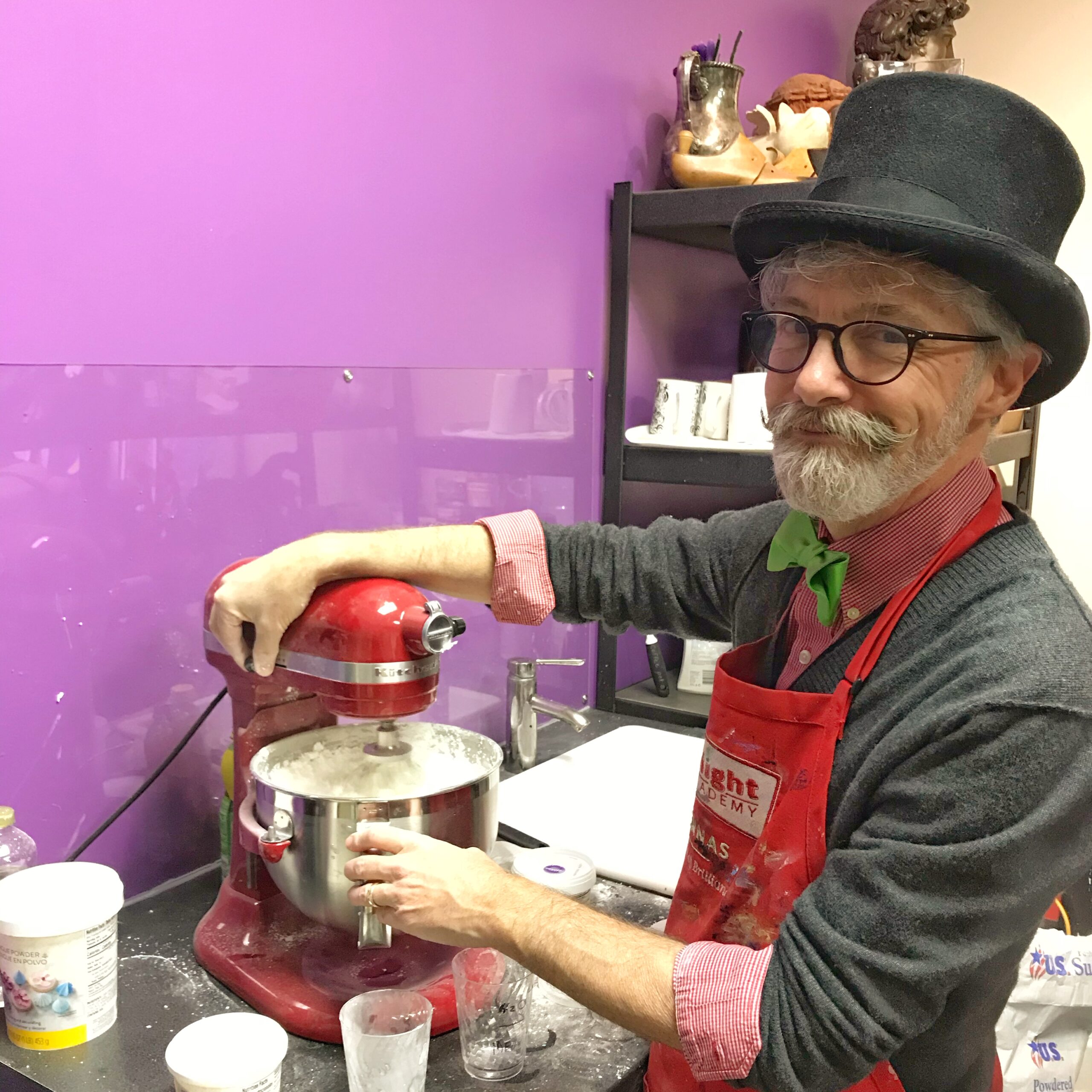
Mr. Dennas makes all the frosting! (it doesn’t taste good – just for show)

We will be managing all the frosting and candy. Kids are allowed two small pieces or one big one for snacking during construction. That is all.

We Can’t Wait! See you soon.

Crazy Brains.

I’d like to write a collumn for parents of artists. Here’s an article I wrote that I’d like to see in a newspaper or magazine. Let me know what you think. I’ve updated this based on some input.

Crazy Brains.
by Dennas Davis

So, your child runs into the room holding a big wad of toilet paper with bits of tape all over it, bringing you their new creation that is… well, quite the mess, is the first thing that comes to mind. The important question though, is which side of your brain will be the first to actually speak?

You have two sides to your brain and each is different. It’s a race. One side is going to win. Do you know which? Does most of your thinking come from your right brain or your left? The scientists say that left brains are for logic and reasoning, while the right side is all about intuitive thought (where the crazy muse resides). I hear people say all the time, that they’re left-brained, or right-brained. Last time I checked though, I had a both sides of my brain fully intact and functioning. I’ll bet you have both too. You can do the wacky creative thing some of the time and also keep track of important reasonable stuff at other times. It’s your brain, and you have the ability to switch sides as you need to.

Your kids have a wonderfully versatile two-sided brain, and they seem to be able to jump back and forth from logic to intuitive (left to right) so fast it’ll make your brain spin. They’ll also use the crazy side of the brain, (the right), a lot more than most adults. But kids know that crazy is good. I think we need to be a little more crazy. Or, if you prefer, more childlike and free in our thinking. More right-brained!

Children love to create crazy things. We think that some children, however, grow out of their creative youth and become “left-brainers”, like doctors, lawyers, and mathematicians, (while others retain so much craziness they can’t even spell “mathematicians” without a spell-checker. I had to try three times.) Then there are still others, who seem to be right-brained and creative yet deny it, believing that part of them is silly or somehow wrong – maybe crazy.

You can’t imagine how many times I’ve heard a grownup say, “I used to love to… [fill in the blank], but now I don’t do that anymore”. It makes me sad, because I hear the child who loved something creative, still in there wanting to get back to being a little bit crazy. But what if creativity is still in there? What if it just gets squashed out of the heart instead of not enduring the trip into those “rational” adult brains? I’m pretty sure that all “left-brain” adults have a right brain. It still works too – so it must the heart that changes.

So how do we keep our own kids crazy? How do we make sure that their hearts enjoy the brain’s creative side all the way into adulthood? I think the answer begins with a bite to the tongue and a left-brain time out. You see, while not a scientist, and without any data other than my own observation, I think our tongues are mostly connected to our left brain. We analyze all the pressures of the adult world and want to apply it to everything and everyone. We tend to be critical. All that left-brain pressurized control pops out without a second thought. Quit it. That left brain has too much control already, (it does like control), and it will fight for world domination almost as much as you fight over the TV remote with your spouse. Sure, there are many times you need to operate from your left brain, but there are also times when the right brain must be in charge.

For instance, when you see your child run in with that big wad of toilet paper, you might exclaim, “what are you doing with all our good toilet paper!” There it is. That would be your left brain taking over, analyzing the misappropriate use of TP, and trying to not have to pay for more of it. The child immediately hears you saying that their creative use of the paper is NOT good. That means their creative side is NOT good. Are you really going to be upset about the cost of a roll of toilet paper in 20 years when your kid gets the nobel prize for new toilet paper technology? What if your child asked you for a “short roll of soft & fluffy art-sculpting paper” that costs less than a buck? wouldn’t you buy it? In this scenario, the left brain is kind of stupid, thinking that toilet paper has only one use and is actually expensive. Kids know better of course, because they let the right brain loose more often. So bite your tongue. Give your right brain a chance for the second thoughts to emerge.

Your crazy right brain is far more capable to understand and speak during this moment. When engaged properly, it can easily find something positive within almost any odd-looking artistic endeavor. Look hard. Let the crazy side find the good in the proud but weird work in front of you. When you find it, speak it. “Wow! I never would have used toilet paper to make a boat. What an amazing, out-of-the-box idea. You are very creative”.

Now another word of important advice: don’t ever make up compliments and say something you don’t really believe. Kids’ know it when you’re in spin mode. You should not, for instance, say, “That’s the coolest, best-made boat I’ve ever seen,” because it’s not, and then when your child says, “Then let’s go put it in the bathtub!” you’ll have to continue responding with your logical-but-clueless-in-this-moment, left brain: “Uh. that might not be such a good idea for the coolest, best-made boat ever”, or worse, “Great idea! I’ll go get the video camera.” If your child asks a valid question such as, “do you think it will float?” you should say what you believe to be true; “no, I’m pretty sure it won’t float, but you can pretend it does on our blue blanket.”
“but I thought it would float!” (begins crying).
“The people who make toilet paper make sure that it won’t ever float, so it’s not your fault, but you made a cool cloud boat out of it. You’re a cloud boat inventor!”
“I am?” (stops crying). “wow!”
This is an excellent example of the right brain being clever and saving the day.

So, how do you change the way you usually respond? My right brain has come to help. I’ve compiled a crazy little ditty to help you remember how to control the left brain, and let the right side take charge when needed. When you see something from your child’s right brain creativity emerge, whatever it is, and no matter what it looks like, immediately bite your tongue and think, “R-I-G-H-T”. This is a neat little acronym that goes like this:

Respect. Turn and talk to your child with respect. They’ll learn it only from you.
Interest. Make sure to give your attention fully to what he or she is interested in.
Good thing. Find at least one thing that is good. (This is the center of the word. Cool.)
Ha ha. Be fun & happy. This creates a positive atmosphere, and makes the “H” work.
Truth. Only speak the truth. What you actually believe.

But what if (I can almost hear you asking), your child’s creativity burst into your world in an inappropriate way, such as writing on the walls with indelible marker for the fourth time this week? The truth at this point would be a sad time out and/or no TV for a while. However, you want to make sure that even during a reprimand, that you validate their creative tendencies. The thing to remember, is that the creative action – drawing cool pictures with markers – is different from the rebellious action – knowingly defacing the wall. Your child is operating out of both brains and one needs the reprimand, but the other doesn’t. Find a way to help them redirect that fabulous desire to draw onto an acceptable surface. Then let them suffer the consequences of their disobedient behavior. Your own right brain will then want to go out and buy a marker board to stick on their bedroom wall. It might even enjoy making a decorative frame for it. What a crazy idea.

Be a little crazy, and always trust your sense of right.
Mr. D

Dennas is an artist, teacher and crazy parent. His Franklin school, Firstlight Arts Academy is known for the crazy truck he lets his students paint every year.
twitter: @crazytruck or online: firstlightart.org